Tampilkan postingan dengan label potatoes. Tampilkan semua postingan
Tampilkan postingan dengan label potatoes. Tampilkan semua postingan
Minggu, 15 Mei 2016
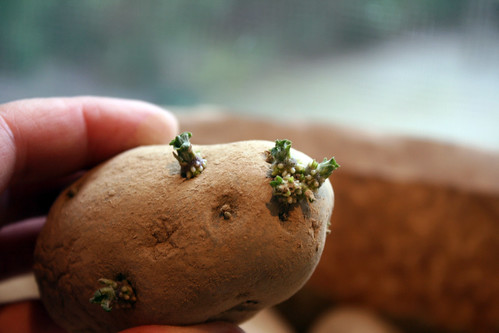
sprouted potatoes
After 3 weeks of sprouting on my window sill, this is how my potatoes look. No, I did not sit and watch them the whole time. ;-) Tomorrow, I have two potato planting events scheduled. I'll help the kids at the Wheelock School in Medfield MA plant their potatoes and then I'll go to my community garden plot and plant my own potatoes. It's potato planting time!!

Kamis, 14 April 2016
sprouting my seed potatoes
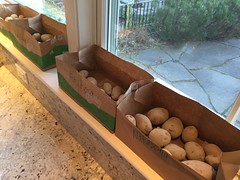
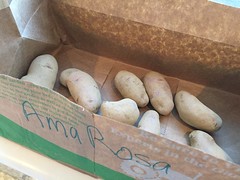
I like to sprout my seed potatoes before I plant them. They're all sitting on my kitchen windowsill now. I'm looking at them and wondering: does a watched potato sprout? (silly...)
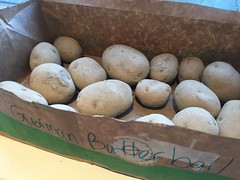
Potatoes are hardy enough to be planted outside now. One reason I'm sprouting them inside is I haven't prepared my potato beds yet. It's been chilly and I've been busy. But I have been researching how to prepare the beds. (They're at my community garden.) I looked up whether potatoes like a fertile soil and I found all sorts of different answers: some site say they're light feeders, others say heavy feeders! OK, so a Google advanced search of only .edu sites, voila!, they are heavy feeders. All the extension sites agree.
I didn't realize potatoes are heavy feeders and so I haven't given them much compost in the past. This year I want to put on a good 2 inches of compost. That means I'll need 1 cubic yd (27 cu ft). Compost is so expensive, especially when purchased by the bag. I think I'll bring compost from my home bins to my community garden. I've generated a lot of compost in the past year and I figure the effort to transport it is similar to transporting bags of compost. So that's on my to-do list next week.
At my Master Gardener class today, the speaker talked about SOIL. A great topic! The head of the soil testing lab at the Univ of Conn (Dawn Pettinelli) gave a super 5 hour soil course. She told us that pH is the most important parameter to keep track of in garden soils (drainage too). She mentioned that potato scab is one of the plant diseases affected by soil pH. (I hate digging up potatoes and finding them covered in scab.) She said that at a pH lower than 5.2, the scab pathogen won't grow (the potatoes will), so this is one approach to prevent scab. But if you lower the pH in your potato bed, it makes it hard to rotate plantings. So she said - grow resistant varieties. OK, I did select for scab resistance in the varieties I have this year. Hopefully I'll have scab-free potaotes this year.
Potatoes are hardy enough to be planted outside now. One reason I'm sprouting them inside is I haven't prepared my potato beds yet. It's been chilly and I've been busy. But I have been researching how to prepare the beds. (They're at my community garden.) I looked up whether potatoes like a fertile soil and I found all sorts of different answers: some site say they're light feeders, others say heavy feeders! OK, so a Google advanced search of only .edu sites, voila!, they are heavy feeders. All the extension sites agree.
I didn't realize potatoes are heavy feeders and so I haven't given them much compost in the past. This year I want to put on a good 2 inches of compost. That means I'll need 1 cubic yd (27 cu ft). Compost is so expensive, especially when purchased by the bag. I think I'll bring compost from my home bins to my community garden. I've generated a lot of compost in the past year and I figure the effort to transport it is similar to transporting bags of compost. So that's on my to-do list next week.
At my Master Gardener class today, the speaker talked about SOIL. A great topic! The head of the soil testing lab at the Univ of Conn (Dawn Pettinelli) gave a super 5 hour soil course. She told us that pH is the most important parameter to keep track of in garden soils (drainage too). She mentioned that potato scab is one of the plant diseases affected by soil pH. (I hate digging up potatoes and finding them covered in scab.) She said that at a pH lower than 5.2, the scab pathogen won't grow (the potatoes will), so this is one approach to prevent scab. But if you lower the pH in your potato bed, it makes it hard to rotate plantings. So she said - grow resistant varieties. OK, I did select for scab resistance in the varieties I have this year. Hopefully I'll have scab-free potaotes this year.
Rabu, 13 April 2016
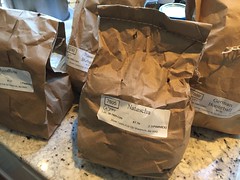
seed potatoes arrived today
My seed potatoes from Moose tubers arrived today. My plan: let them sprout a couple weeks, while I amend their beds, then plant them. I have the tubers on my kitchen windowsill so I can watch them sprouting. To amend the beds, I want to add a good 2 inches of compost and dig it in. No scimping this year! I want my spuds in happy soil.
Minggu, 17 Januari 2016
potato order
I've decided on my potato selection for this year. 4 types, all from Fedco Moose Tubers:
Natascha, v. early, yellow skin/yellow flesh, waxy, high yield, high scab res
AmaRosa, mid-late, red skin/red flesh, waxy, high yield, high scab res
German Butterball, late, yellow-russet skin/yellow flesh, med/dry texture, med/high yieid, exel storage
Russet Burbank, late, russet skin/white flesh, dry texture, high yield, high scab res., exel storage
Last year I restrained my self to one variety, spaced the eyes out nicely, and ended up with a very poor harvest. I'm looking forward to abundance this year!
Jan 18: I've just placed my order. Some things are already selling out at Moose Tubers. Fortunately they still had the four varieties I want, but conventional only - the organic ones were sold out. I was surprised at their shipping charge of $15 on my $21 order (10 lbs total), but I want these varieties and I suppose 10 lbs isn't like shipping little seed packets. (Thanks for the correction below.)
In placing the Burbank Russet order I see this note: "This dependable standard requires heavy feeding and regular moisture for exceptional performance." I'll have to remember that. I neglected both with the Russets I grew last year and had a very low harvest.
Natascha, v. early, yellow skin/yellow flesh, waxy, high yield, high scab res
AmaRosa, mid-late, red skin/red flesh, waxy, high yield, high scab res
German Butterball, late, yellow-russet skin/yellow flesh, med/dry texture, med/high yieid, exel storage
Russet Burbank, late, russet skin/white flesh, dry texture, high yield, high scab res., exel storage
Last year I restrained my self to one variety, spaced the eyes out nicely, and ended up with a very poor harvest. I'm looking forward to abundance this year!
Jan 18: I've just placed my order. Some things are already selling out at Moose Tubers. Fortunately they still had the four varieties I want, but conventional only - the organic ones were sold out. I was surprised at their shipping charge of $15 on my $21 order (10 lbs total), but I want these varieties and I suppose 10 lbs isn't like shipping little seed packets. (Thanks for the correction below.)
In placing the Burbank Russet order I see this note: "This dependable standard requires heavy feeding and regular moisture for exceptional performance." I'll have to remember that. I neglected both with the Russets I grew last year and had a very low harvest.
Langganan:
Postingan (Atom)