Rabu, 27 April 2016

planting asparagus
I am SO busy with my Gardening Class added to spring planting on top of my usual work, but the asparagus I ordered arrived in the mail yesterday - so, it's time to plant asparagus! I need to move a few wheelbarrows full of compost over to the bed I have planned for them, turn it under, then plant the crowns. Last time I planted asparagus, I set the crowns in wrong. I dug them up and replanted them. So this is my second time planting crowns and I'll know what I'm doing (I hope). I'll add some pictures of the process.
Kamis, 21 April 2016
today's harvest
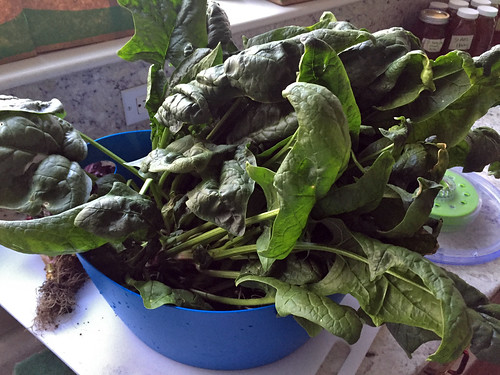
Today's harvest was a big bunch of spinach and a couple small heads of red romaine from my winter tunnel. I made sauteed spinach with pesto on pasta and pork tenderloin for dinner. It was yummy.
Senin, 18 April 2016
mom's garden
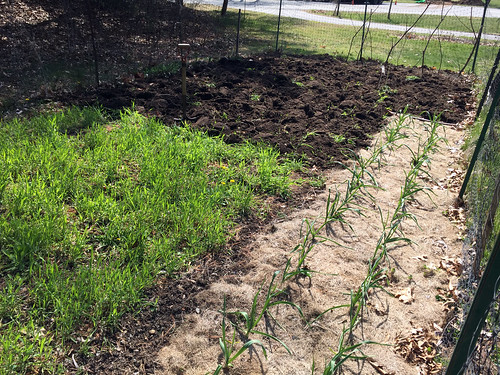
My mom's garden looks pretty good. I planted winter rye that did very well over the winter. I am gradually working on turning it under. I planted Super Sugar Snap peas at the far end of this photo and have branches in for support. Mom's garlic looks really good. It's about the 3rd or 4th year now that I have used a portion of her harvest for replanting.
Sabtu, 16 April 2016
transplanting tomatoes
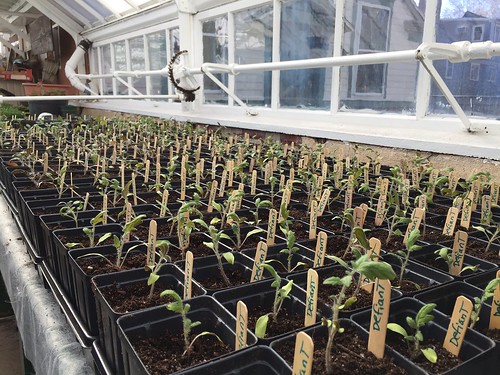 photo by Amelia Fannin
 A group of volunteers from my community garden got together and transplanted tomato seedlings yesterday. We do this every year. They are late blight resistant tomatoes: Jasper, Mountain Merit, Defiant and Iron Lady. We transplanted about 360 seedlings. We raised them at home under lights and now they'll be raised by Sandra Curro at Underwood Greenhouses. They'll be distributed free to any of our 135 gardeners who want them. Extra plants will be for sale at Underwood Greenhouses beginning May 7: 20 School St, Belmont MA.
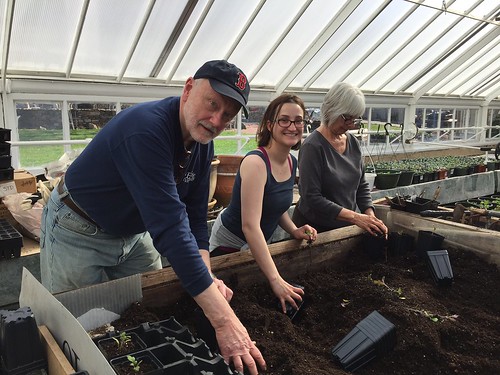 photo by Amelia Fannin
Kamis, 14 April 2016
sprouting my seed potatoes
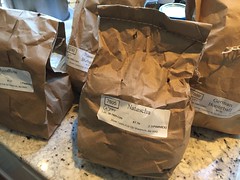
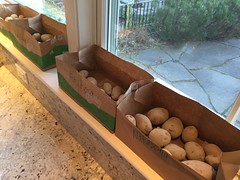
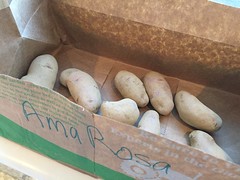
I like to sprout my seed potatoes before I plant them. They're all sitting on my kitchen windowsill now. I'm looking at them and wondering: does a watched potato sprout? (silly...)
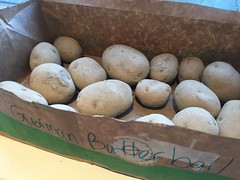
Potatoes are hardy enough to be planted outside now. One reason I'm sprouting them inside is I haven't prepared my potato beds yet. It's been chilly and I've been busy. But I have been researching how to prepare the beds. (They're at my community garden.) I looked up whether potatoes like a fertile soil and I found all sorts of different answers: some site say they're light feeders, others say heavy feeders! OK, so a Google advanced search of only .edu sites, voila!, they are heavy feeders. All the extension sites agree.
I didn't realize potatoes are heavy feeders and so I haven't given them much compost in the past. This year I want to put on a good 2 inches of compost. That means I'll need 1 cubic yd (27 cu ft). Compost is so expensive, especially when purchased by the bag. I think I'll bring compost from my home bins to my community garden. I've generated a lot of compost in the past year and I figure the effort to transport it is similar to transporting bags of compost. So that's on my to-do list next week.
At my Master Gardener class today, the speaker talked about SOIL. A great topic! The head of the soil testing lab at the Univ of Conn (Dawn Pettinelli) gave a super 5 hour soil course. She told us that pH is the most important parameter to keep track of in garden soils (drainage too). She mentioned that potato scab is one of the plant diseases affected by soil pH. (I hate digging up potatoes and finding them covered in scab.) She said that at a pH lower than 5.2, the scab pathogen won't grow (the potatoes will), so this is one approach to prevent scab. But if you lower the pH in your potato bed, it makes it hard to rotate plantings. So she said - grow resistant varieties. OK, I did select for scab resistance in the varieties I have this year. Hopefully I'll have scab-free potaotes this year.
Potatoes are hardy enough to be planted outside now. One reason I'm sprouting them inside is I haven't prepared my potato beds yet. It's been chilly and I've been busy. But I have been researching how to prepare the beds. (They're at my community garden.) I looked up whether potatoes like a fertile soil and I found all sorts of different answers: some site say they're light feeders, others say heavy feeders! OK, so a Google advanced search of only .edu sites, voila!, they are heavy feeders. All the extension sites agree.
I didn't realize potatoes are heavy feeders and so I haven't given them much compost in the past. This year I want to put on a good 2 inches of compost. That means I'll need 1 cubic yd (27 cu ft). Compost is so expensive, especially when purchased by the bag. I think I'll bring compost from my home bins to my community garden. I've generated a lot of compost in the past year and I figure the effort to transport it is similar to transporting bags of compost. So that's on my to-do list next week.
At my Master Gardener class today, the speaker talked about SOIL. A great topic! The head of the soil testing lab at the Univ of Conn (Dawn Pettinelli) gave a super 5 hour soil course. She told us that pH is the most important parameter to keep track of in garden soils (drainage too). She mentioned that potato scab is one of the plant diseases affected by soil pH. (I hate digging up potatoes and finding them covered in scab.) She said that at a pH lower than 5.2, the scab pathogen won't grow (the potatoes will), so this is one approach to prevent scab. But if you lower the pH in your potato bed, it makes it hard to rotate plantings. So she said - grow resistant varieties. OK, I did select for scab resistance in the varieties I have this year. Hopefully I'll have scab-free potaotes this year.
Rabu, 13 April 2016
seed potatoes arrived today
My seed potatoes from Moose tubers arrived today. My plan: let them sprout a couple weeks, while I amend their beds, then plant them. I have the tubers on my kitchen windowsill so I can watch them sprouting. To amend the beds, I want to add a good 2 inches of compost and dig it in. No scimping this year! I want my spuds in happy soil.
Langganan:
Postingan (Atom)